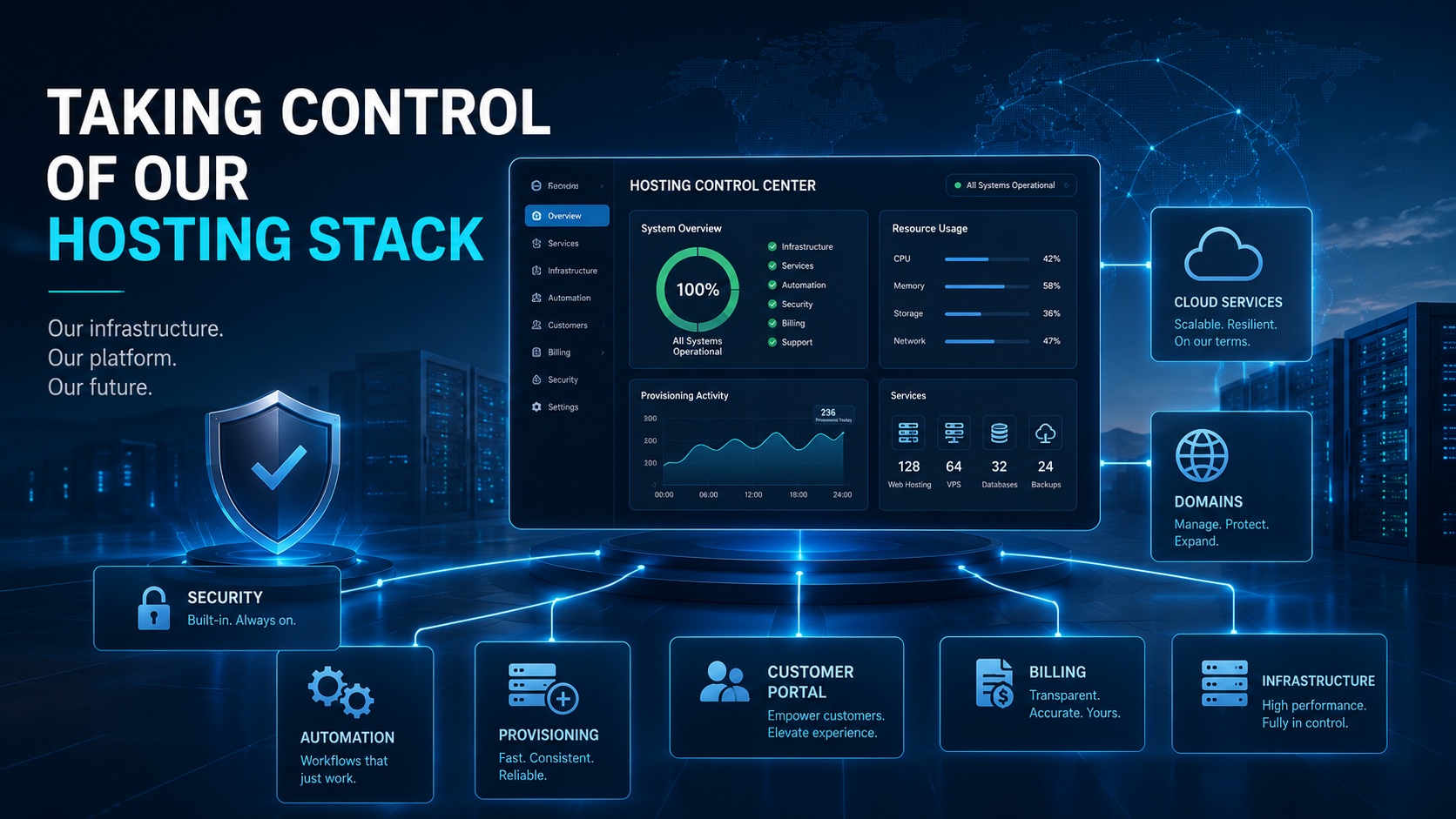
For a long time, hosting companies have depended on platforms like WHMCS to manage billing, customers, domains, support tickets, hosting packages, renewals, and automation. There is a reason for that. A hosting business is not the same as a normal online store. A customer is not just buying something once and walking away. They are buying a service that needs to be created, renewed, supported, monitored, upgraded, suspended, fixed, migrated, and sometimes recovered when something goes wrong.
So the billing platform becomes more than billing. It becomes one of the control points of the business.
That is powerful, but it also creates a dependency. At Tecative, we have been looking closely at that dependency, not because the existing tools are bad, but because we wanted to ask a bigger question: how much control do we want over our own hosting stack?
The Existing Options
There are good tools in the market, and each one has strengths and trade-offs.
WHMCS is well known and widely used, but it can feel dated and heavily tied to the traditional hosting model.
Blesta has a cleaner developer feel and strong billing foundations, but you may still need to build around it for more advanced workflows.
HostBill is powerful and feature-rich, but it can become complex and expensive.
ClientExec is simpler and easier to understand, but it may feel limited as the business grows.
WISECP has a more modern interface and better customer-facing feel, but you are still operating inside someone else’s model.
Upmind is a good SaaS option with less platform maintenance, but it means your core operating flow depends on a third-party hosted service.
FOSSBilling and Paymenter are interesting open-source options, but open source still needs security, testing, updates, support, and production discipline.
So yes, there are options. The question is not really, “Which one is best?” The better question is: what kind of hosting company are we trying to build?
Introducing HostControl
After looking at the existing options, we decided to take a different path.
At Tecative, we are building HostControl.
HostControl is our hosting automation platform. It is not meant to be a skin on top of someone else’s idea, and it is not just another billing panel with a different logo on it. The goal is to build a hosting control layer around how customers actually think and how we want Tecative to operate.
Most hosting platforms still sell technical pieces: a hosting package, a domain, an SSL certificate, an email service, a backup option, a DNS feature. That may make sense to technical users, but most customers do not think that way.
A customer usually thinks in outcomes.
“I need a website for my business.”
“I need email that works.”
“I need to move away from my old provider.”
“I need help getting online.”
“I need my service fixed.”
That is the gap HostControl is being built to address.
Selling Outcomes, Not Just Hosting Parts
The biggest difference with HostControl is the checkout direction. Instead of making the customer figure out every technical piece, HostControl is being designed to guide them toward the result they are trying to achieve.
For example, a customer should be able to start with something simple, like launching a business website, moving a site from another provider, setting up professional email, protecting a website, or fixing a hosting issue.
Behind the scenes, the platform can still handle the technical work: billing, payment, domain setup, hosting, SSL, email, backups, provider actions, and customer notifications. But the customer should not have to see all of that noise. They should know what is happening, what is completed, what needs attention, and what comes next.
That is the kind of experience we want to build: less confusion, less jargon, less guessing, and more clarity for the customer.
Where HostControl Is Today
HostControl has already moved beyond the early prototype stage. We now have separate areas for the admin side, the customer portal, and the public website. The platform has its own backend and database. Customer login, profile management, billing, invoices, payments, refunds, credits, taxes, discounts, and payment provider groundwork are already moving into place.
We also have the foundation for service provisioning, provider checks, scheduled jobs, customer timelines, checkout flow, CMS/blog improvements, and hosted entitlement support for Tower Work Management. In plain English, this is becoming a real operational platform, not just a mockup.
There is still work to do, but the direction is clear.
What Still Needs Work
The biggest unfinished work is not simply adding more pages. The important work is making everything connect properly.
Orders need to flow cleanly from checkout, to payment, to provisioning. Provider integrations need real-world testing. Failed orders need recovery flows. Admins need one clear place to see what is stuck, what needs attention, and which customers are impacted.
We also need stronger roles and permissions, better notifications, backup and restore, deployment documentation, and a full production security review. That part matters because it is easy to build something that works when everything goes right. The real test is what happens when something fails: a payment does not go through, a provider is unavailable, a provisioning job gets stuck, a customer enters the wrong information, an SSL certificate does not issue, or a renewal does not match the provider status.
That is where a hosting platform has to be strong.
The Admin Side Matters Too
The customer experience is important, but the admin side matters just as much. If we are going to run our own platform, we need proper operational visibility.
A good hosting platform should not make staff hunt through invoices, tickets, logs, provider screens, payment screens, and scheduled jobs just to understand what happened. It should bring the important work forward and show what failed, what needs action, which customer is impacted, what can be retried, what needs manual review, what is waiting on payment, what is waiting on a provider, and what changed today.
That is one of the areas we are focusing on next.
The Goal
The goal is not to take an existing hosting panel and build our version of the same thing. That would miss the point. HostControl is about building the hosting platform we actually want to operate at Tecative: one that is easier for customers, cleaner for admins, more transparent when something goes wrong, and more connected to how we want to deliver services.
There are good tools in the market, and they all have their place. WHMCS, Blesta, HostBill, ClientExec, WISECP, Upmind, FOSSBilling, Paymenter, and other platforms solve real problems. But every third-party platform comes with trade-offs. Some are technical, some are operational, and some are financial.
Licensing, add-ons, modules, support renewals, hosted platform fees, and integration costs all become part of the cost of delivering the service. Over time, that affects pricing flexibility. The more overhead we carry in the background, the less room we have to discount services, build stronger bundles, support smaller customers, or adjust pricing when it makes sense.
That is why HostControl matters to us. It gives Tecative a way to invest in our own platform, shape the customer experience directly, and build an operating model that supports how we want the business to grow.
For us, HostControl is not just a software project. It is a strategic move to secure our independence, protect our pricing flexibility, and build the customer experience we believe Tecative should deliver.
Comments (0)
No comments yet. Be the first to comment!









Leave a Comment