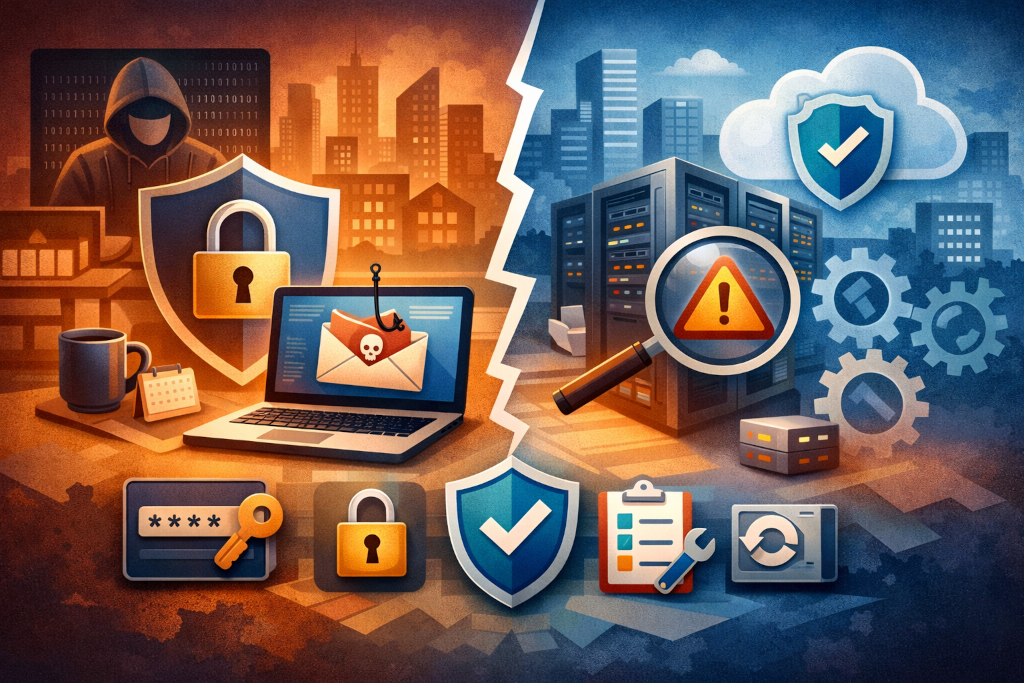
Cybersecurity is no longer a concern reserved for banks, governments, or massive tech companies. Today, small and medium businesses are just as much a target as large enterprises, often more so. Attackers do not care how big you are. They care how easy you are.
At the same time, cybersecurity is not only about expensive tools, advanced monitoring, or complex architectures. Many breaches still happen because of basic mistakes. Weak passwords. Unpatched systems. Shared accounts. Clicking the wrong link.
That is where cybersecurity hygiene comes in.
The Reality for SMBs
Small and medium businesses often believe they are “too small to be targeted.” In practice, they are targeted precisely because they usually lack mature security programs.
SMBs tend to have:
-
Fewer dedicated IT or security staff
-
Limited budgets
-
Heavy reliance on cloud services and third parties
-
Employees wearing multiple hats with broad access
From an attacker’s perspective, this is ideal. A single compromised mailbox can lead to invoice fraud, ransomware, stolen customer data, or full network access. For many SMBs, one serious incident can mean weeks of downtime, reputational damage, or even closure.
Cybersecurity for SMBs is about survival, continuity, and trust.
The Enterprise Challenge Is Different, Not Easier
Enterprises face a different problem. Complexity.
Large organizations operate hybrid environments with on-prem infrastructure, cloud platforms, remote users, contractors, OT systems, and third-party integrations. The attack surface is massive, and small gaps add up quickly.
Enterprises may have advanced tools like SIEMs, EDR, IAM, and SOC teams, yet still suffer breaches because:
-
Accounts are over-privileged
-
Legacy systems remain unpatched
-
Exceptions become permanent
-
Security processes are bypassed “to get work done”
At scale, poor hygiene does not create a small problem. It creates systemic risk.
Cybersecurity Is Not Just Tools
A common misconception is that buying a security product equals security. In reality, tools only work when the foundation is solid.
Cybersecurity is a combination of:
-
Technology
-
Process
-
People
-
Discipline
Without hygiene, even the best tools fail.
You can deploy MFA, but if users reuse passwords, you still have a problem.
You can install endpoint protection, but if systems are never patched, you are exposed.
You can monitor logs, but if service accounts are shared and undocumented, alerts lose meaning.
What Is Cyber Hygiene?
Cyber hygiene refers to the basic, repeatable practices that reduce risk day after day. They are not glamorous, but they are effective.
Good hygiene includes:
-
Strong, unique passwords and password managers
-
Multi-factor authentication everywhere possible
-
Regular patching of operating systems, applications, and firmware
-
Least-privilege access and role-based permissions
-
Removing stale accounts and unused access
-
Email awareness and phishing training
-
Backups that are tested, not just configured
These steps alone can prevent a significant percentage of real-world attacks.
Why Hygiene Gets Ignored
Hygiene is often neglected because it feels boring, inconvenient, or invisible when it works. It does not generate headlines or dashboards full of flashy metrics.
But attackers rely on that neglect.
They count on organizations delaying patches.
They count on password reuse.
They count on exceptions that never get reviewed.
They count on humans being tired and rushed.
Good hygiene removes easy wins from attackers and forces them to work harder, making your organization a less attractive target.
Cybersecurity Is a Business Function
Whether you are an SMB or an enterprise, cybersecurity is not just an IT issue. It is a business issue.
It affects:
-
Operations and uptime
-
Financial risk and fraud exposure
-
Legal and regulatory obligations
-
Customer trust
-
Brand reputation
Strong security combined with good hygiene supports growth rather than blocking it. When done right, it enables safe digital transformation instead of slowing it down.
Final Thought
Cybersecurity does not have to be overwhelming. It starts with fundamentals.
Advanced defenses matter, especially at scale. But they only work when the basics are done consistently and correctly.
Comments (0)
No comments yet. Be the first to comment!









Leave a Comment